
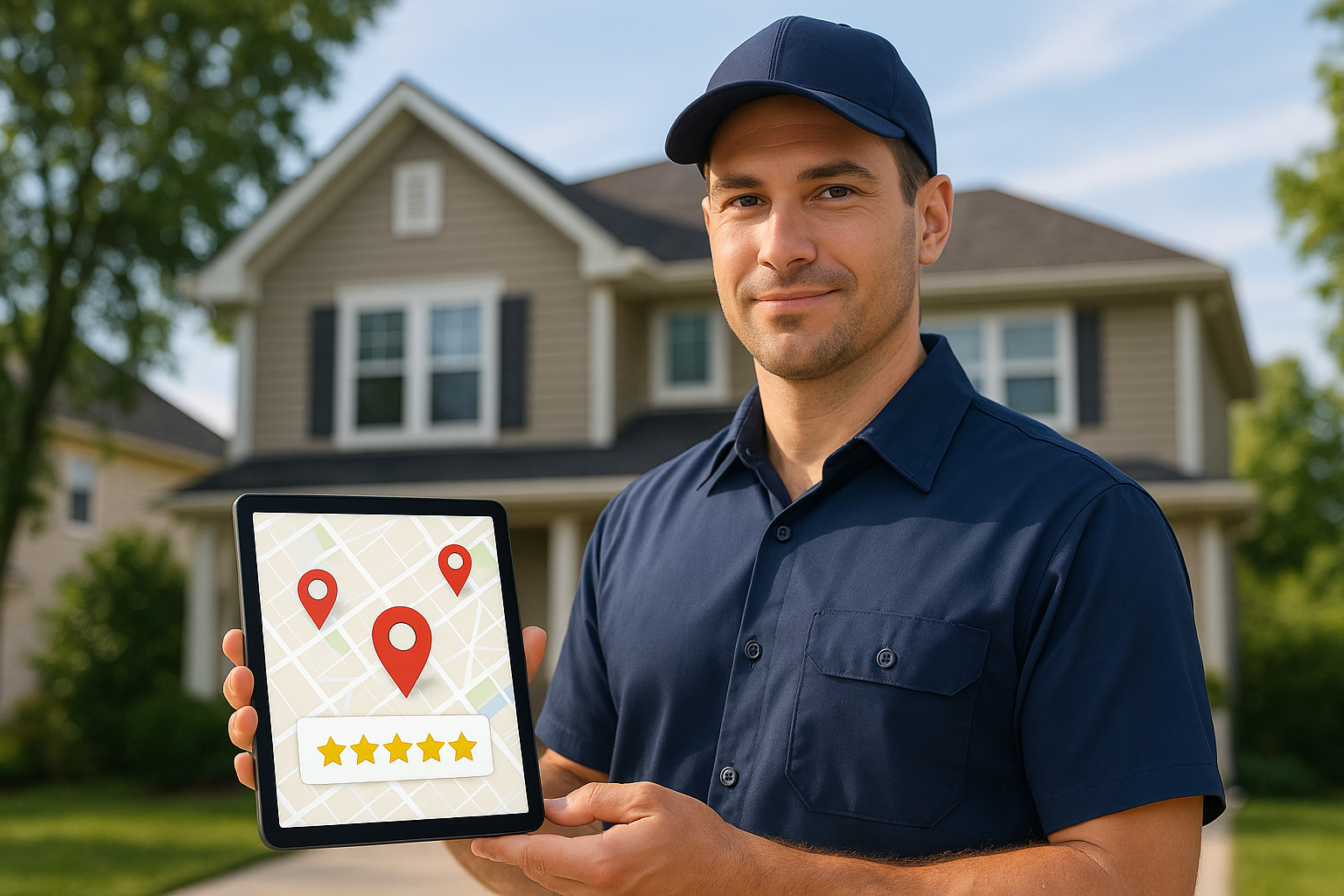
If you run a home service business, you don’t need “more marketing ideas.” You need more booked calls from the people already searching for what you do.
That’s exactly what local SEO is for.
Local SEO isn’t a mysterious algorithm game—it’s a set of assets (your Google listing, your site, and your reputation) working together. When those assets are consistent and complete, you show up more often in the map results, look more credible than competitors, and convert more clicks into phone calls.
Below is a 2026 local SEO checklist built specifically for home service businesses (HVAC, plumbing, roofing, electrical, cleaning, landscaping, and similar trades).
1) Google Business Profile: lock in the basics (and don’t skip the “boring” parts)
Your Google Business Profile (GBP) is the foundation of map pack visibility.
- Business name: Use your real-world name—no keyword stuffing.
- Primary category: Choose the closest match to your main service.
- Additional categories: Add only the services you truly offer.
- Service areas: Add the cities/ZIPs you actually serve.
- Hours: Keep them accurate (including holiday hours).
- Phone number: Prefer a direct line that’s consistent everywhere online.
- Website link: Point to your homepage or (even better) a strong “service + location” landing page.
Pro tip for home services: If your phone rings most from emergencies (HVAC no heat, plumbing leaks), make sure your hours and “open now” status reflect reality. Being “closed” in GBP can cost you calls.
2) Build a GBP profile that converts, not just ranks
Ranking is only half the job. The other half is making the searcher choose you.
- Business description: 1–2 short paragraphs explaining who you serve, what you specialize in, and what makes you different.
- Services: Add each core service as its own service entry.
- Products: Use “Products” for high-value offerings like “AC Tune-Up,” “Water Heater Installation,” or “Roof Inspection.”
- Attributes: Add what’s relevant (e.g., “On-site services,” “Veteran-led,” etc.).
- Appointment URL: If you have online booking, link it.
Conversion tip: Write your description like a real person is reading it on their phone at a stoplight. Clear beats clever.
3) Photos & videos: make your company feel real
In 2026, photos are still one of the easiest levers for both trust and engagement.
- Upload real photos weekly (not stock): Team in uniform, trucks/ vans, before/after shots, “on the job” action shots, office/shop photos.
- Add short videos (10–20 seconds): walk-around, quick intro, jobsite clip.
Goal: When someone compares 3 businesses in the map pack, you want your listing to look alive.
4) Reviews: get more, respond better, and turn them into ranking fuel
Reviews don’t just influence clicks—they’re a local ranking factor and a reputation asset.
- Ask for reviews right after a win moment (job completed, customer relieved).
- Use a short, direct review link.
- Don’t “bribe” for reviews—keep it clean.
- Respond to every review (yes, even the 5-stars). Mention the service + city naturally.
Simple response template:
Thanks, [Name]! We’re glad we could help with your [service] in [city]. If you ever need anything else, we’re here.
For negative reviews: Respond calmly. Offer to resolve offline. Never argue in public.
5) NAP consistency + citations: stop leaking trust
NAP = Name, Address, Phone. Google cross-checks your business info across the web.
- Ensure your business name, address formatting, and phone number match everywhere.
- Fix the big data sources first (major directories).
- If you’re a service-area business and don’t show your address publicly, keep the GBP settings consistent.
Why this matters: Inconsistent listings create uncertainty. Uncertainty lowers trust. Lower trust means fewer impressions and fewer calls.
6) Your website: build “service + location” pages that actually help
Many home service sites are missing the pages that convert local intent.
- Create a strong page for each primary service: /ac-repair/, /water-heater-installation/, /roof-repair/
- Create location-focused landing pages for major areas: /plumber-austin/, /hvac-round-rock/
- Each page should include: Clear headline, what you do, common problems you solve, your process, proof (reviews, photos, badges), FAQs, and strong CTAs
Avoid the trap: Don’t make 30 near-duplicate city pages. If you can’t write a real page, build fewer—better.
7) Quick wins you can do this week
If you want momentum fast, do these 5 things:
- Add 10–20 real photos to GBP.
- Add/clean up your top services in GBP.
- Respond to the last 20 reviews (use service + city naturally).
- Improve your #1 money service page (headline, proof, FAQ, CTA).
- Fix NAP inconsistencies on your top directories.
Want help turning this into a weekly system?
Local SEO works best when it’s treated like operations—not a one-time project.
If you want a simple plan tailored to your market and your services, Vortex Local can help you:
- Optimize your Google Business Profile
- Build location + service pages that convert
- Generate more 5-star reviews
- Track what’s actually driving calls
Ready to grow? Reach out and we’ll map the fastest path to more local leads.
Balint Adorjan is the Founder and Owner of Vortex Local, helping home service businesses grow through reputation management, Google Business Profile optimization, and all-in-one business software.